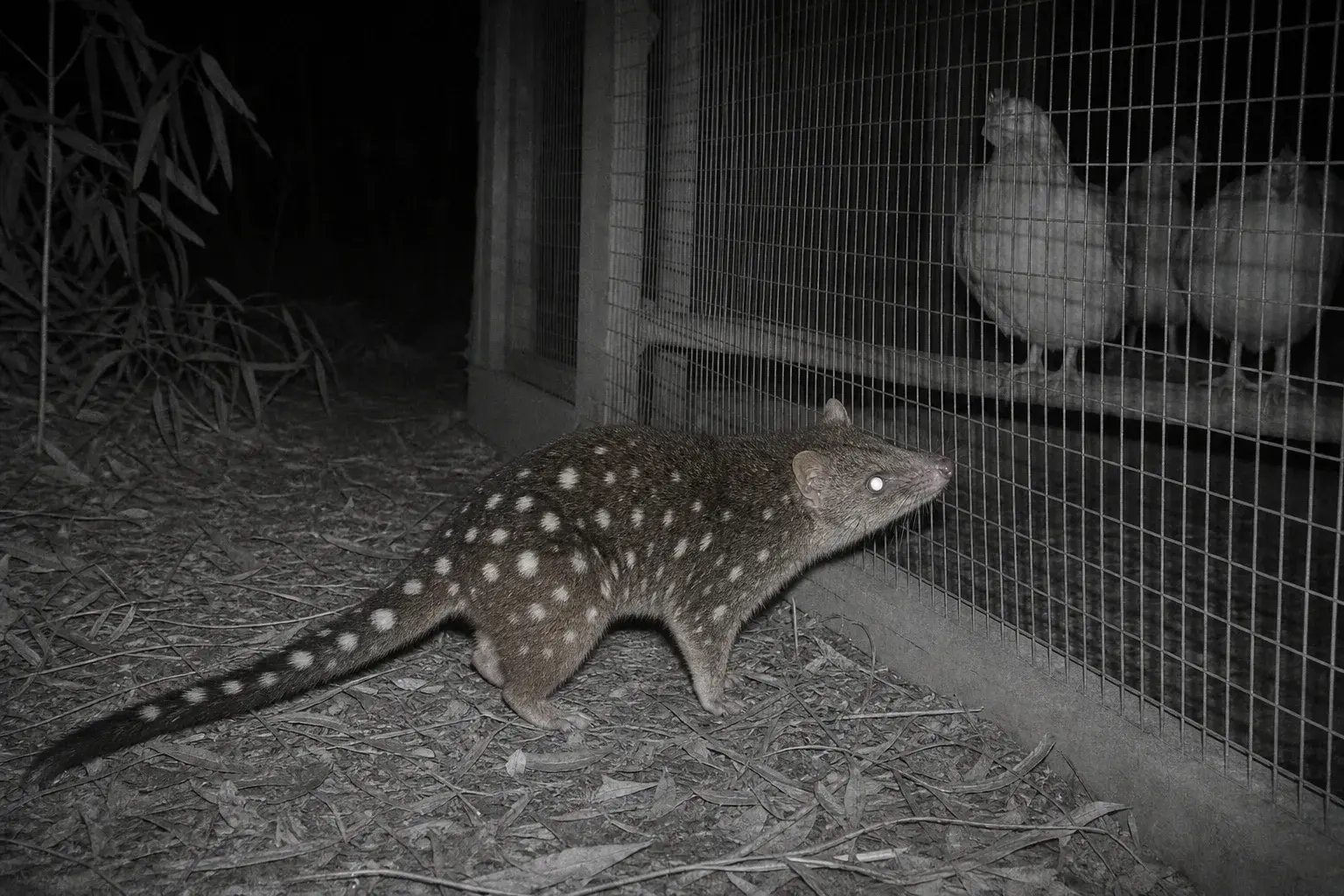
Why is a quoll in the chook pen at all?
The spotted-tailed quoll is mainland Australia's largest carnivorous marsupial, about the size of a domestic cat but with shorter legs. Males average about 3 kg and females 1.5 to 2 kg3. Quolls hunt on the ground and in trees, take prey from possums to rabbits, and are well known for taking domestic fowl3. They are mainly nocturnal, but they hunt by day as well3.
They also cover ground. Females range over 175 to 500 ha on average and males over 750 to 3,000 ha, and a quoll can travel several kilometres in a night3. Young males wander further during the breeding season, following creek lines to hunt6. If you keep chooks near forest, NSW guidance is blunt: you are likely to have quolls checking out your animals1.
The species is listed as vulnerable in NSW and endangered nationally1. Past trapping, shooting and poisoning by people protecting chooks contributed to that decline, and some quolls died of injuries from trying to get in or out of pens1. A badly built pen harms both animals. A well-built one is a small act of conservation.
Other states have their own version of this story. Western Australia's chuditch weighs about 1.5 kg, is still illegally killed for raiding poultry, and can travel up to 5 km in a night5. Tasmania has both spotted-tailed and eastern quolls4.
What makes a pen quoll-proof?
NSW publishes eight tips, and the first three do most of the work1. Use 10 to 15 mm spot-weld aviary mesh on the walls. Give the pen a roof or a mesh canopy with no gaps larger than 20 mm. If the floor is earth, take the mesh or walls at least 400 mm below ground, which also matters for keeping out foxes.
The reasons are physical. Quolls are smaller than people expect, they climb superbly, they dig, and adults can chew through thin wire1. Recycled materials are fine, as long as you follow the same gap and depth rules and fix them so they cannot be forced apart1.
Advice elsewhere lines up. Tasmania suggests a pen 1.5 m high and well footed, in palings, corrugated iron or mesh, with a roof, a floppy top or electric wire4. Western Australia suggests a concrete slab if possible, or a 30 cm trench lined with brick, timber, concrete or mesh, plus small-gauge spot-weld mesh and a roof5. The numbers differ a little. The logic does not: no way over, through or under.
What if the flock free-ranges?
Daytime is harder, because quolls do not keep strict hours. Tasmania's advice is frank that free-range poultry without high perches cannot reasonably be protected4. The answer is a safe place to go. NSW suggests isolated trees with a tin collar around the trunk about 1.5 m up1, and Tasmania suggests a tree with no branches within 1.5 m of the ground4.
Mobile chook tractors are vulnerable too. Peg a wire skirt around the base, or use the tractor by day only and lock birds in a permanent coop at night1. Electric fences can help retrofit an existing house, though NSW warns they are costly and need significant maintenance1.
What is legal if a quoll is already visiting?
Start by finding out what it is. Tracks and wildlife cameras can separate quoll from fox or dog1. If it is a quoll, contact your Local Land Services or National Parks and Wildlife office, which may help with a motion camera or with safely trapping and relocating the animal1.
Do not do that part yourself. Trapping quolls is illegal in NSW, where native mammals other than dingoes are protected under the Biodiversity Conservation Act 20162. Traps can injure quolls, and females can drop young from the pouch1. In Tasmania, trapping and relocating devils or quolls is illegal and setting poison is too4. It is also illegal to harm chuditch in Western Australia5. Shoalhaven City Council warns of significant penalties7. This is general information rather than legal advice, so check with your state agency.
Who pays for all this?
You do, because the pen is yours, and none of these guides puts a price on it. The cost is mostly better mesh and more digging, and it buys protection from far more than quolls1. In return you keep your flock, and a threatened predator keeps its life.