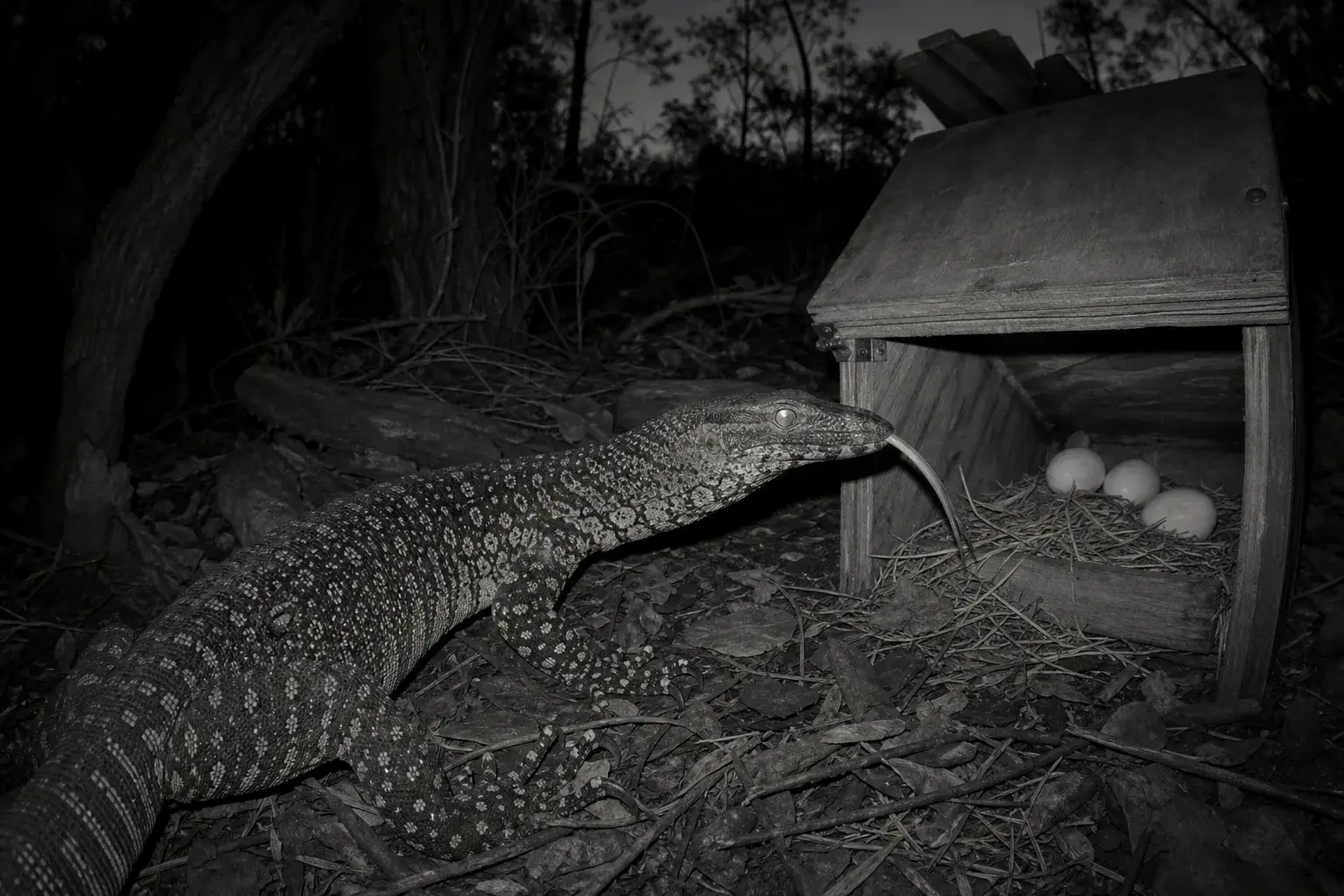
Why do goannas go for eggs?
Because eggs are food. NSW National Parks lists eggs in the lace monitor's diet, along with reptiles, birds and mammals1, and South Australia's fact sheet adds insects, frogs, rabbits and carrion2. Rosenberg's goanna eats eggs too10. As WIRES puts it, eggs are a natural part of the diet of many native animals3.
So a goanna at the nest box is not a rogue animal that has learned a bad habit. It is a large reptile doing its normal rounds, and it has found a box that refills itself. On a bush block that is worth remembering, because no amount of chasing will change what the animal is looking for. The hens are also not the only birds on the menu. South Australian rangers say you may first notice a lace monitor when you hear birds swooping to drive it from their nests2.
Lace monitors are big. They can reach 2 m and 14 kg2, which puts them among the largest lizards in the country1. They are more active in warm months and rarely seen in cool ones2. A GPS study found winter movement was greatly reduced7, so expect egg trouble to build with the warm weather and fade in winter.
How does a goanna get in?
Up, mostly. Lace monitors are agile climbers2 with long, strong claws, and they spend much of their time in large trees, coming down to forage11. A coop roof that looks safe from a fox may be a short walk from an overhanging branch. They also search for food both in trees and on the ground2, so a gap at the base of a wall is just as useful to them.
Your coop is probably on somebody's route. Adult males over 5 kg in one study had home ranges averaging 65.5 ha7, and a lace monitor can move up to 1 km in a day2. Once one has found eggs, expect it back. Shutting the birds in at dusk only protects them at night, so it does not solve this particular problem on its own: the nest box and run have to hold up during the day as well.
What keeps them out?
A properly enclosed run. WIRES recommends chicken mesh fine enough to stop pythons and monitors in particular3. The RSPCA's yard advice fits the same job: fully roof the coop, block every access point, lay small tough wire mesh on the ground around the coop and under its floor, cover it with soil, and trim overhanging branches8.
If you want numbers, use the NSW quoll-proof specification. It was written for quolls, but the state says it also keeps out goannas, pythons, foxes, dogs and ravens5. That means 10 to 15 mm spot-weld aviary mesh, a roof or canopy with no gaps over 20 mm, and at least 400 mm of mesh or wall below an earth floor5.
Then think about the nest box, since that is what the goanna came for. RSPCA guidance suggests boxes about 30 cm square, one for every two to four hens, with a closable rear hatch so you can collect eggs without disturbing the birds9. A hatch that latches properly is the part that matters here. Pick eggs up early in the day and often through the warm months, so there is less for a passing lizard to find.
What if one is already in the coop?
Keep your distance and give it a way out. WIRES normally advises simply opening the coop so the goanna can make a quick retreat3. Keep dogs and children back. Goannas are not naturally aggressive, but their claws and teeth are very sharp and they may use them if threatened2. When scared they tend to climb the nearest tree2, so stay out of the way between the animal and any trunk.
Do not hurt it. All native reptiles are protected in NSW under the Biodiversity Conservation Act 20166, the lace monitor is shown as protected on the state's parks site1, and Rosenberg's goanna is listed as vulnerable in NSW10. Other states have their own rules, so treat this as general information and check with your wildlife agency. If an animal is hurt or stuck, call a licensed rescue group.
Do not feed it either. South Australian rangers ask people not to feed native wildlife, and to store food securely so that goannas are not drawn in2. The same goes for scraps near a chicken run.
Who pays?
You do, and it is mostly a one-off job. Nobody subsidises a coop roof, and none of these guides prices one. The work overlaps with quoll and fox proofing, so a single build covers most of the threats on a bush block5.