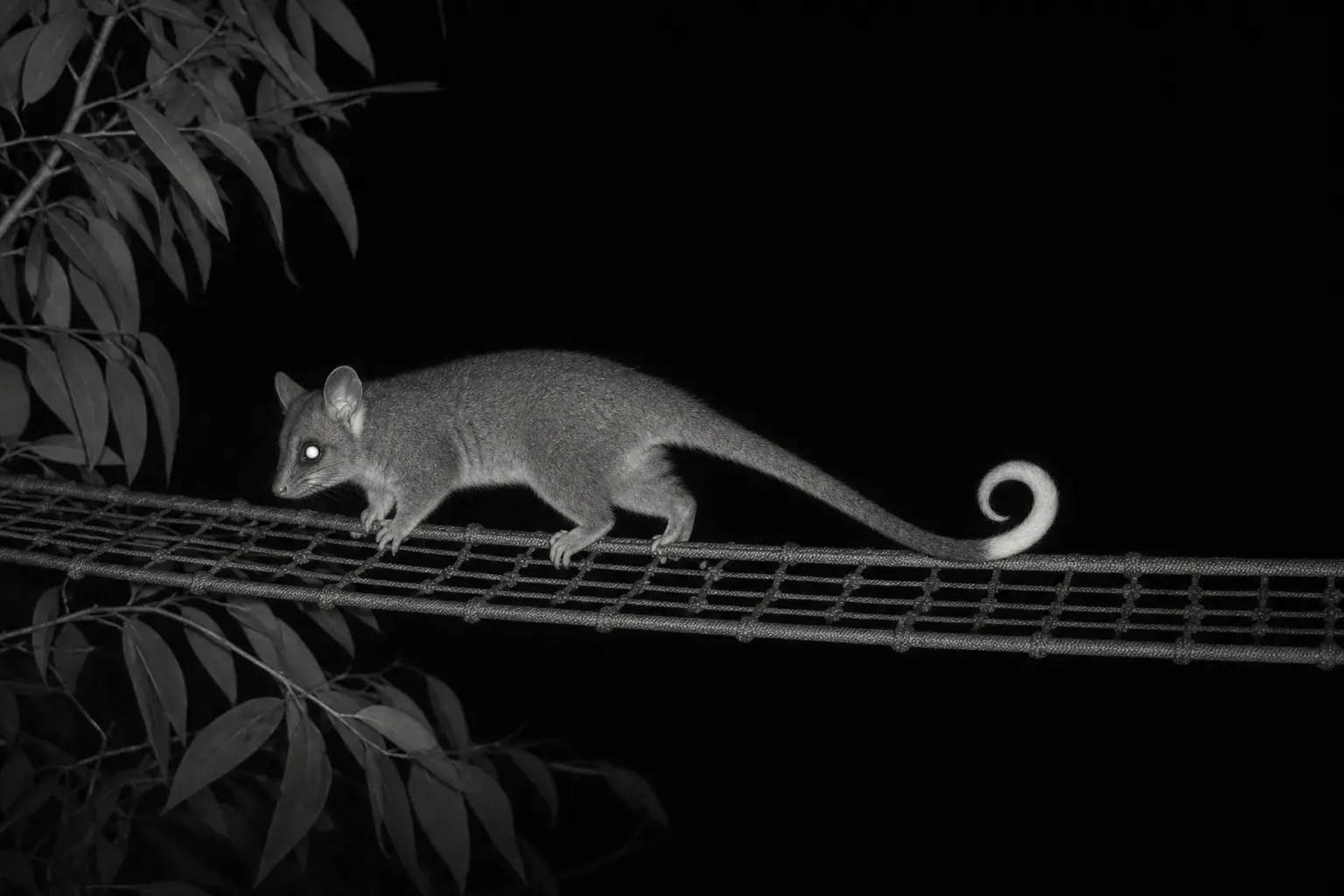
What is a rope bridge for wildlife?
A rope bridge, also called a canopy bridge, joins the tree canopy on one side of a road to the canopy on the other. Most are a flat net or ladder a few dozen centimetres wide, slung on steel cables between timber poles, with extra ropes running in from nearby branches so animals can find the way on4.
The idea is simple because the problem is simple. Possums and gliders live off the ground, and the road surface is where they die. Near Busselton in Western Australia, researchers fitted radio collars to 70 western ringtail possums and followed them for 40 months. Only three tried to cross the road, and two of those were killed3.
Sizes vary a lot. On the Hume Freeway in Victoria the nets are about 15 mm marine-grade rope woven 50 cm wide, 60 to 85 m long and at least 6 m above the road4. The Caves Road bridge near Busselton is a narrower 300 mm strip, about 26.5 m long2.
How do we know animals really cross?
Mostly from motion cameras, which is why the evidence is unusually good for such a modest structure. Conservation Evidence, a review project that sorts conservation methods by what the studies show, found ten studies of rope bridges. Eight were Australian, nine recorded mammals using the bridges, and the method is rated as beneficial1.
The counts are hard to argue with. In Queensland's Wet Tropics, nine mammal species used trial bridges, with more than 50 crossings on one ladder over a 15 m tourist road5. On the Pacific Highway in NSW, cameras caught six species on five bridges, from squirrel gliders to feathertail gliders, plus introduced black rats1. On the Hume, one stretch of monitoring logged 455 crossings by squirrel gliders, 386 by common ringtail possums, 229 by common brushtail possums and two by brush-tailed phascogales1. Both possum species were filmed carrying dependent young across4.
Use is uneven, though. Rates on Pacific Highway bridges were 0.02 to 0.08 crossings a night for each species, against 2.47 a night for squirrel gliders on one Hume bridge and 8.87 a night for western ringtails late in the Caves Road study2. Two of the five Hume bridges were not used by any species during monitoring4. Big totals can also flatter. Microchip readers showed that the high rates at two Hume bridges came from three or four animals crossing again and again4.
Which animals do not use them?
Koalas are the clearest no. A NSW trial strung four bridge designs 8 to 11 m between trees in a small patch of forest on a university campus. Over about three years, koalas turned up 75 times in two nearby trees and never once on a bridge, while mountain brushtail possums made 22 passes1. Cameras along the Hume recorded no koalas on any structure in 3,929 nights, although the species lives in the area4.
Rainforest specialists can hold back as well. A bridge over a road through restored rainforest in north Queensland was crossed regularly by common brushtail, green ringtail and Herbert River ringtail possums, but no lemuroid ringtail possums were recorded near it. The study links that difference to how much each species depends on mature forest6.
Weather plays a part too. Western ringtails crossed less on windy nights, probably because an open bridge leaves them exposed2.
Does a bridge change anything for the population?
That is the harder question. Most monitoring documents use, not the effect on populations or roadkill1. The strongest test comes from the Hume, where researchers genotyped 399 squirrel gliders from before and after the structures went in. The freeway turned out not to be a complete genetic barrier, with a strong effect at only one site, Longwood. There, a rope bridge restored gene flow within five years7. So a bridge can repair a real break, but not every site has one to repair.
What does one cost, and who pays?
Road agencies and government usually pay. The Caves Road bridge cost A$10,000 in 2013, funded by Main Roads WA and the state parks department3, and the Wet Tropics researchers describe rope bridges as inexpensive5.
The bill does not stop at construction. Reaching monitoring gear over the Hume took an elevated work platform, a licensed operator and lane closures at about A$5,000 to A$10,000 a day4. Bridges need looking after as well. In 2025 a 130 m bridge at Meridan Plains on the Sunshine Coast was replaced with new ladder-style netting8.