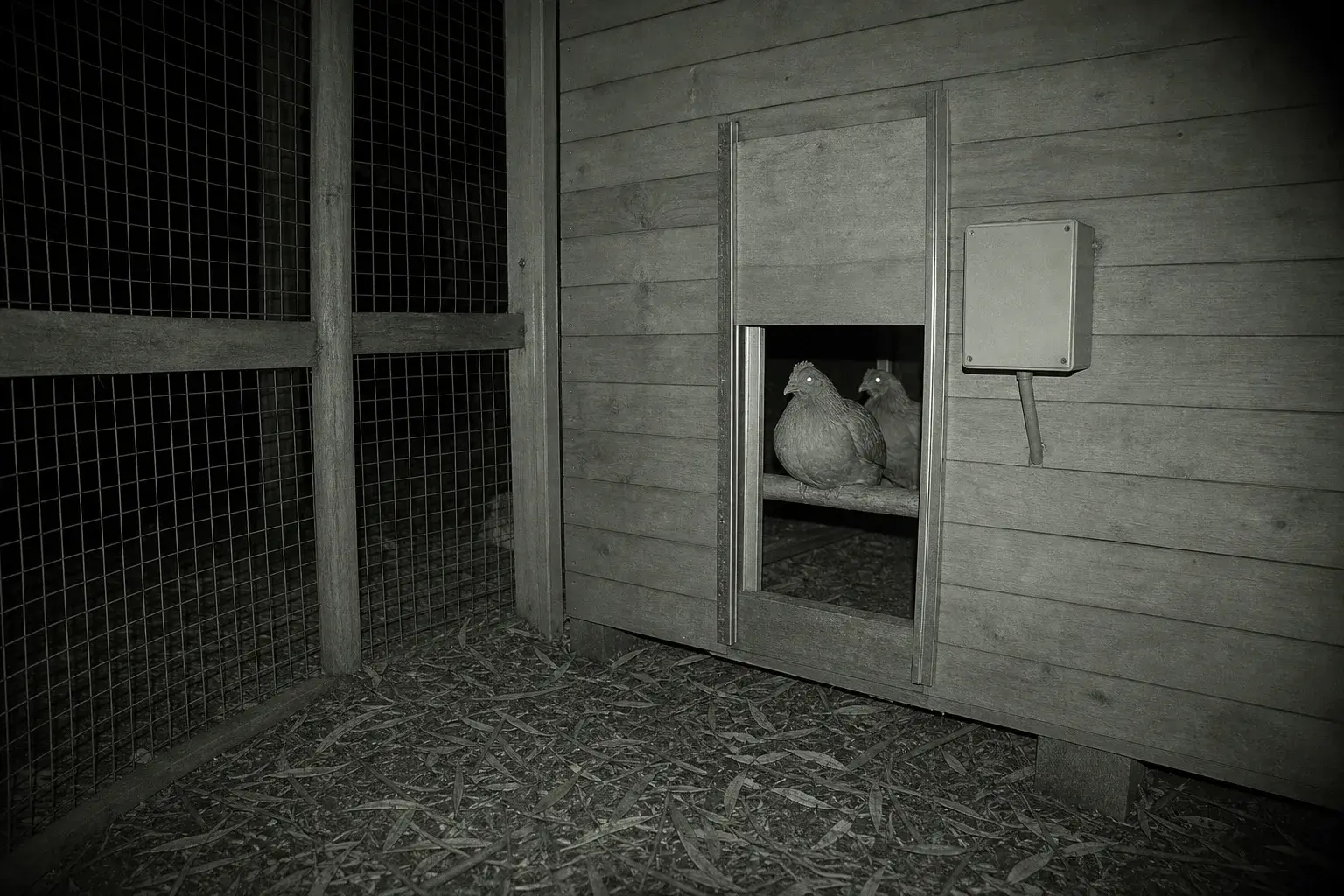
What problem does an automatic door solve?
Night is the dangerous shift. Brisbane City Council tells poultry keepers to secure birds overnight, when foxes are most active2. Agriculture Victoria says housing must keep birds safe from foxes, snakes and cats, especially at night5. In NSW, the advice for any pen that is not quoll-proof is to secure the birds in a night roost11. The RSPCA says to lock chickens in at night even if they free-range all day3.
All of that assumes somebody is there at dusk, every dusk, for years. People get stuck at work, go away or simply forget, and one open night can be expensive. Foxes are surplus killers that can kill a whole coop of birds without eating them12.
An automatic door takes the human out of that one step. Chickens are creatures of habit that come home at about the same time each evening and like to roost in the same place3, and they instinctively look for a high roost to sleep on4. A door that shuts soon after they settle fits that behaviour well. It is also one of the measures Western Australian conservation staff list for keeping chuditch away from poultry1.
How do the doors decide when to close?
They run on a timer, a light sensor or both10. The difference between them comes down to how far the sun moves where you live.
In Hobart on 21 June 2026 the sun sets at 4:42 pm and civil twilight, the period when the sun is less than 6 degrees below the horizon, ends at 5:15 pm6. On 21 December those times are 8:49 pm and 9:24 pm7. Daylight saving accounts for one of those hours, but a door on a clock still has to follow all four. Darwin barely moves, from 6:30 pm in June to 7:10 pm in December89. A fixed timer can do the job in Darwin with few changes. In Hobart it would need regular resetting.
A light sensor tracks all of that without help, which is why it suits southern blocks. Its weak spots are local ones: a coop in deep shade, or a dark storm, may read as dusk early, while a yard light may read as day. Test yours at your own site. Whichever you use, the WA wording is the one to keep in mind. The door should close when it is dark and the chickens have returned1, and that second condition is the one you have to check yourself.
What can go wrong?
Plenty, and most of it is not the motor's fault.
The bird that misses the bell is the obvious one. A hen outside at closing time is shut out for the night, with no warning to you. Then there is the door itself. Brisbane's specification calls for a fox-proof door2, and a light slide that drops under its own weight may not meet that test if a fox can lift it from outside. At least one maker sells a separate self-locking kit, which tells you the concern is real10. Power is the third risk, because a flat battery or a jammed runner leaves the door where it stopped.
The last problem is false confidence. A door protects the opening and nothing else. Foxes are excellent diggers and adept climbers2, quolls can chew thin wire and dig11, and a run with soft edges stays soft however clever the door is. Goannas forage in daylight, so a night door does nothing for your eggs.
We should also be plain about the evidence. We found no independent Australian trial comparing losses with and without automatic doors. The claims in circulation come mainly from makers and retailers, so read them as marketing.
What does a door cost, and is it the right first spend?
One maker's Australian range listed door openers at A$225 to A$295 in 2019, with a self-locking door kit at A$7010. Prices will have moved since, and cheaper units exist. Set that against the job of making the coop sound. Brisbane's fox-proof design uses 10 mm wire buried at least 450 mm, or a 500 mm apron angled outwards, with a roof and no gaps2. The NSW quoll-proof version asks for 10 to 15 mm spot-weld mesh and 400 mm below ground11.
Do that work first. A locked door on a weak coop is a good lock on a cardboard box. On a sound coop, an automatic door is a sensible way to protect the birds on the nights life gets in the way.