What does a camera trap actually record?
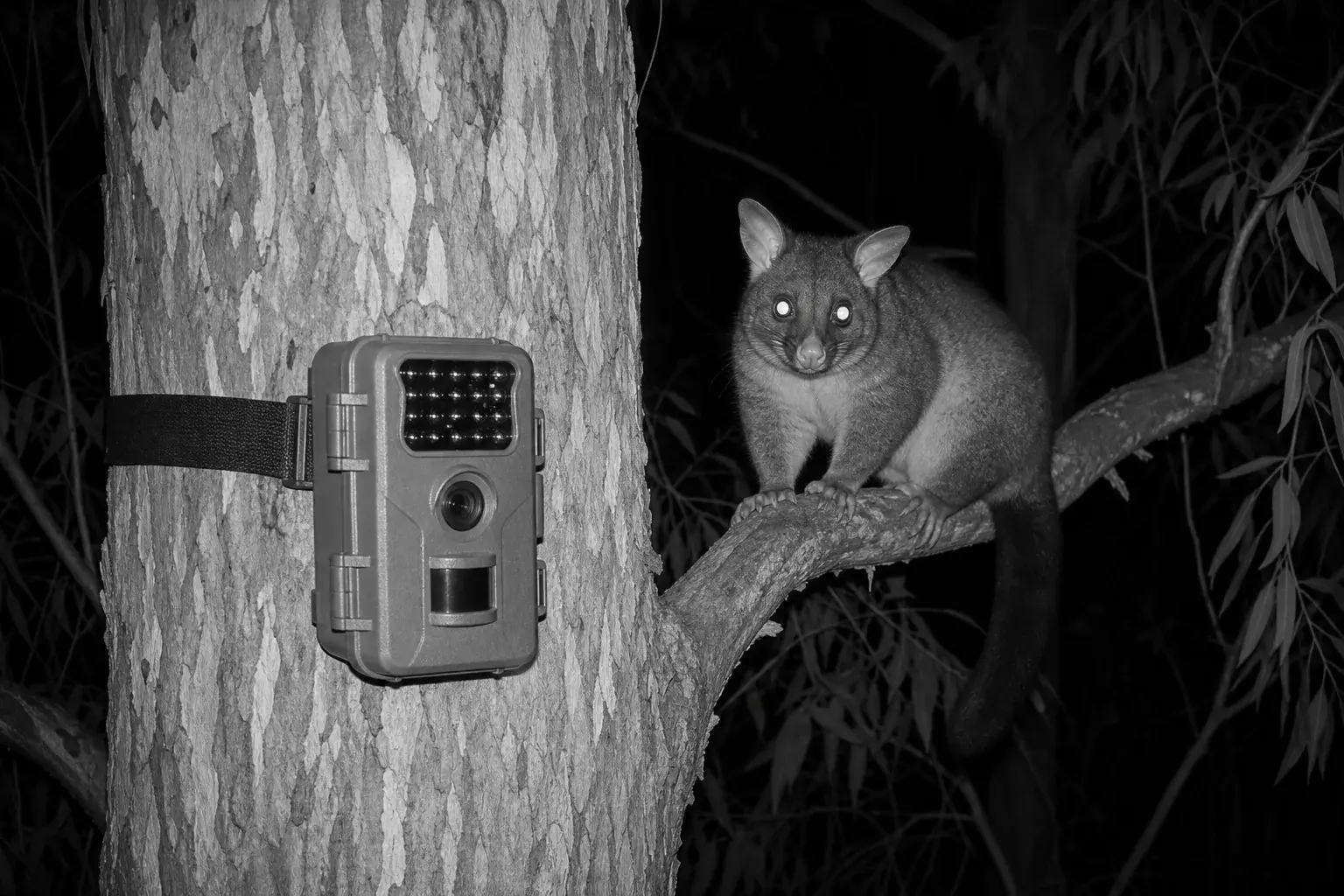
A camera trap is a weatherproof camera that fires when something moves in front of it, and uses infrared light to see in the dark. On a crossing it lives high up. On a section of the Pacific Highway in the Kempsey area, cameras sit at the top of each pole and at each end of every rope bridge, fed by a solar panel and a battery, with an infrared sensor on the bridges to trigger them and wireless download to a laptop at ground level2. Near Busselton in Western Australia, a pair of optical sensors at each end of a bridge set off three consecutive photos4.
What comes back is a stack of time-stamped frames. They are good at telling you the species and poor at telling you what happened between frames. Most arguments about crossings live in that gap.
When does a photo count as a crossing?
Every study has to decide. Near Busselton, a crossing was complete if an animal left one side and arrived on the other within 10 minutes, and partial if it turned back4. On the Pacific Highway, the test was the same species at both ends in rapid succession2. Along the Hume Freeway, only 42 of 1,112 detections at bridges were classed as visits, so nearly every animal on a bridge there was crossing it1.
Gliders make this harder. They can land anywhere on a structure, so a camera trained on one spot may miss the arrival3. The Pacific Highway monitors got around that by treating a glider on a median pole as an assumed crossing, since it had to travel over a carriageway to get there3.
Can a camera tell one animal from another?
Rarely. On the Hume, features such as body size, scent glands and ear notches could be made out on only 445 of 2,291 occasions1. That matters, because a thousand crossings might be a thousand animals or three.
So researchers implanted microchips, known as PIT tags, and fitted readers to the five Hume bridges. The high crossing rates turned out to be three or four animals going back and forth. Two squirrel gliders and one common brushtail possum crossed almost every night, which suggests they had folded the bridge into their home range1. That is a useful result, and a very different one from "lots of animals cross here".
The gear is fragile, because it lives on a pole beside live traffic. Equipment faults meant only 5 to 27% of Hume reader detections could be confirmed as crossings1. Near Busselton, readers malfunctioned regularly and logged five chipped animals on eight nights4. Reaching equipment on the Hume took a work platform and lane closures at about A$5,000 to A$10,000 a day, so regular repairs were not feasible1. On the Pacific Highway, theft wiped out the autumn 2019 camera data3.
What can camera counts not prove?
They cannot show that a structure was needed, or that it changed anything for the population. Rope bridge monitoring typically documents use rather than population effects7. A real test compares sites before and after a structure goes in, against sites that got nothing. Ecologists call this design BACI, for Before-After-Control-Impact6.
The Hume experiment did that. Researchers genotyped 399 squirrel gliders, 191 from before the structures and 208 from after, across freeway sites with and without structures, sites with tall trees in the median, and quiet roads5. The answer was humbling. The freeway was not a complete genetic barrier, probably because gliders detoured along corridors, and a strong effect showed up at only one site, Longwood. There, a rope bridge restored gene flow within five years5.
Camera counts alone could not have told you that. They also could not have shown which site really needed its bridge. As the journal's associate editor pointed out, use of a structure says nothing about whether the road was a meaningful barrier to begin with6. The authors add a fair counterweight: gene flow is rarely the only goal, and the structures did restore regular movement for gliders living beside the freeway5.
Who pays for the monitoring?
On big projects it comes with the approval. Transport for NSW must manage and monitor the effectiveness of its mitigation on the Pacific Highway upgrade, under a program set by the Minister's conditions of approval2. The Hume work drew on road agencies, the Australian Research Council, universities and wildlife funds9. Monitoring budgets are where the hard questions get answered or skipped, so it is worth asking about them when a crossing is announced.