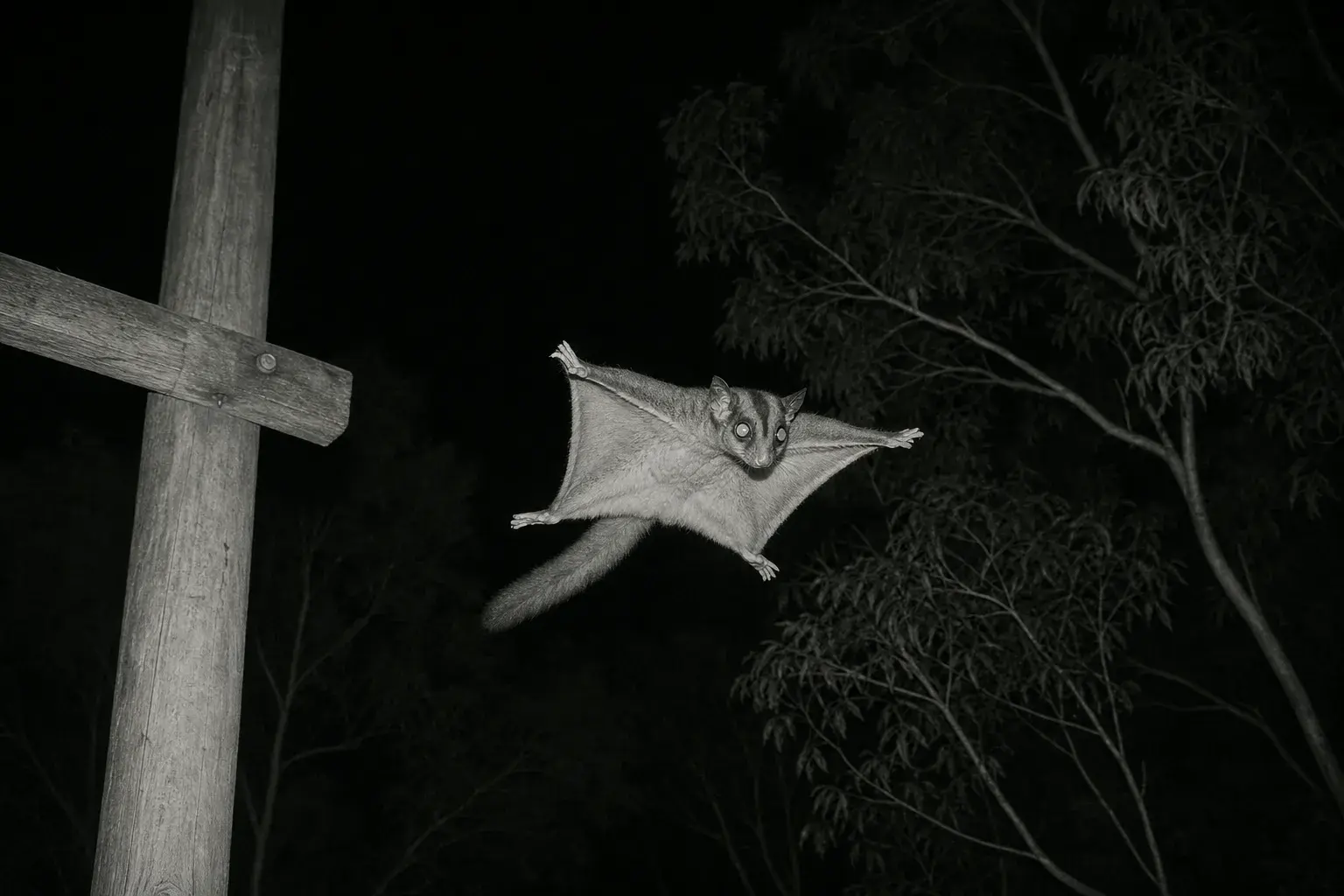
Why can't a glider just glide across?
A glider does not fly. It launches from high up, spreads the skin between its front and hind legs, and spends height to buy distance. A squirrel glider's average glide is 30 to 40 m1. That was probably enough when the Hume in north-east Victoria was a two-lane road. Widening in the 1970s and 1980s turned it into a divided freeway with a treeless gap of 44 to 76 m2, now used by about 10,000 vehicles a day at up to 110 km/h2.
When researchers tracked nearly 50 gliders along the freeway, gaps wider than 50 m were not crossed1. Animals near the road also lived shorter lives, about one year on average against two to four years further away1. No fence was keeping them from the other side. Geometry was.
How does a pole work?
A glider pole is a tall hardwood pole with almost nothing on it. The Hume's poles stand 13 to 18 m tall and 40 to 50 cm thick, with a 2.4 m timber cross-beam fixed 50 cm below the top to act as a launching branch3. A glider lands on the pole, climbs, and takes off again from the top.
The spacing is arithmetic. Designers worked to a glide ratio of 2.5:1, meaning 2.5 m forward for every metre of height lost, and allowed for terrain, the height of roadside trees and clearance over the tallest traffic3. So a glider that drops 10 m travels about 25 m. Poles in the median and on the verges cut the Hume's treeless gap to under 35 m2.
Other roads use other layouts. Queensland trials spanned canopy gaps of 50 to 70 m with lines of five to eight poles, 5 to 12 m high and 5 to 22 m apart4. On wildlife overpasses, lines of eight poles only 6.5 m high gave gliders a route over the top, and no gliders were detected in the middle of overpasses without them4.
The idea is Australian. Ecologist Ross Goldingay proposed it in 1993, and the first poles went up at Bomaderry Creek near Nowra, although they were never monitored5.
Do gliders really use them?
Yes, though the pattern is patchy. Cameras on 15 pole arrays along the Hume filmed 842 crossings by squirrel gliders and 258 by sugar gliders4. At a Queensland site with three 12 m poles around a 61 m gap, gliders were recorded on the poles on 60 of 310 nights, and road crossings were confirmed on 16 of 125 nights4. Near Port Macquarie, sugar, squirrel and feathertail gliders used poles regularly, and yellow-bellied gliders used them twice6. On the Pacific Highway's Frederickton to Eungai section, every pole was used by at least two target species7.
Now the fine print. Four of the 15 Hume arrays went unused by any species3. The analysis hinted that more poles and longer glides reduced use, so fewer poles set closer together may work better, although the sample was only 13 arrays and the estimates were uncertain3. The headline result stays modest as well. With structures in place, gliders were still about half as likely to cross the freeway as to cross quiet, narrow roads1.
Where are poles in use, and who pays?
Glide poles now stand on the Hume, the Pacific Highway and the Bruce Highway, and at Compton Road and Scrub Road in Brisbane5. Species recorded on them include squirrel, sugar, feathertail, mahogany, yellow-bellied and southern greater gliders5.
New road projects can fold mitigation and monitoring into their budgets, but existing roads often have no such funding6. We could not find a published price for a single pole, so we are not quoting one. Tall trees cost nothing to keep, and the Hume researchers recommend both things together: protect vegetation along roadsides and in medians, and build crossings over treeless gaps wider than 50 m2.